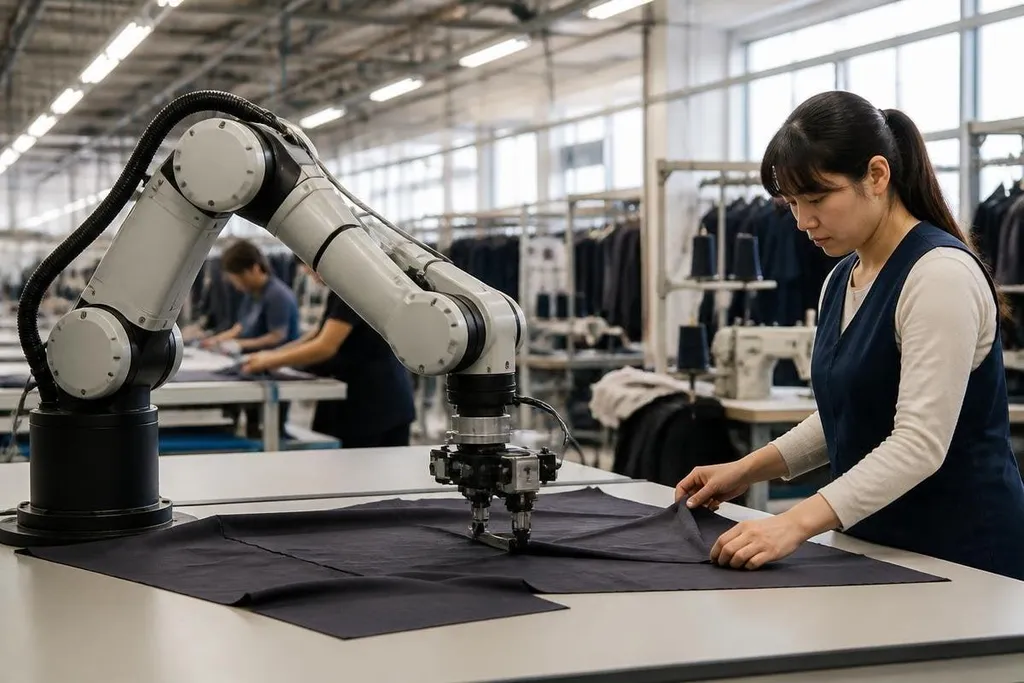
A robot can place fabric, move a cut panel, or check a seam without getting tired. The harder job is keeping soft material flat, aligned, and free from wrinkles as it moves through a garment factory.
Quick read
- Robots are better at repeatable handling than loose fabric
- Cameras and force sensors can help with placement and stitching
- Human workers will still handle many tasks that need touch and judgment
Why fabric is hard for robots
A metal part keeps its shape when a robot picks it up. Cloth does not. It folds, stretches, slips, and can form a new shape each time a gripper touches it.
That makes clothing work different from moving boxes or loading parts into a machine. To work, the system must find the edge of a sleeve, separate one layer from another, and hold the material at the right tension before a needle or cutting tool can do its job.
The problem grows when a garment has several fabric layers. Small changes in tension can shift the layers, so a seam may land in the wrong place. A worker feels that shift through their fingers. A robot needs sensors and software to detect it.
Where robots can help first
The easiest tasks to automate are controlled steps with a fixed start and finish. At first, the robot can move cut panels between stations, place fabric under a sewing head, or sort pieces by shape after cutting.
Machine vision gives the robot a view of the cloth. The system can use cameras to find edges, marks, holes, and seam lines. That information helps the robot position each piece before a tool touches it.
Force sensing adds another layer of control. It measures how hard the gripper presses against the material, so the robot can hold cloth without crushing it or letting it slide. This matters most when the fabric is thin, stretchy, or layered.
The arm can also repeat the same movement across many pieces. That consistency may help with tasks such as folding panels, trimming loose threads, or moving finished parts between stations.
The useful test is simple: does the step repeat often enough to justify the robot, and can the robot recover when a piece is out of place?
Sewing needs more than repeatable motion
Sewing looks like a clear job for automation because the needle follows a set path. The fabric changes that path. It can pull against the needle, bunch near the presser foot, or shift as the machine feeds it forward.
For that setup, the system would need to control the cloth as it approaches the needle, not only move an arm from one point to another. That may call for a gripper on each side, force feedback, and software that checks the seam as it forms.
This is where reports about automation need careful reading. A video of a robot sewing one prepared piece proves that the motion works in that setup. It does not prove the same system can handle different sizes, fabrics, patterns, or damaged pieces during a full shift.
Reports on robots in clothing production can add the missing details: the fabric, task, test date, and human role. Those facts show whether a sewing demo changes a worker’s shift or stays a narrow lab test, which leads into the work people still do beside the machine.
What changes for factory workers
Robots may take over repeated handling steps before they replace whole garment-making jobs. People could still prepare fabric, correct faults, load new patterns, inspect seams, and deal with materials that do not behave as expected.
That shift would change the skills a factory needs. Sewing knowledge would still matter, but workers may also need to set up robot cells, adjust camera views, replace grippers, and check error logs.
The effect will differ from one factory to another. A plant making the same shirt in large batches has more repeatable work than a small workshop making many designs in short runs. The second type may gain more from flexible tools than from a fixed robotic line.
Check the use case before buying
Use this checklist before treating a clothing robot as a fit:
- Name the task: define one repeatable step instead of automating “garment production.”
- Test the fabric: run the robot on the thinnest, stretchiest, and most slippery material in the planned range.
- Count the handoffs: record how often a worker must fix alignment, wrinkles, or layers.
- Check the recovery: see what happens after the robot receives a folded or damaged piece.
- Measure the whole cell: include setup, inspection, maintenance, and worker time beside the robot’s motion time.
The last point often decides the purchase. A robot that moves quickly can still slow the line if a person must stop production to correct small fabric errors.
I’d back robots first in cutting support, material movement, inspection, and other controlled steps. Sewing flexible cloth without regular human correction remains unproven, so the sensible path is a small test cell with a narrow fabric range before a full factory rollout.